From benchmarks to outcomes: A total portfolio approach to fixed income
Benchmarks remain a vital tool for active fixed income investors, but they were never meant to be the final destination. As market dynamics become more complex and investor priorities evolve, allocators are increasingly adopting a total portfolio approach (TPA), focusing more on whether portfolios are delivering the outcomes that matter most to investors.

Key takeaways:
- Moving from benchmark constraints to portfolio outcomes – institutional investors are increasingly applying a total portfolio approach (TPA), evaluating fixed income by the role it plays in achieving overall portfolio objectives – such as income, diversification, risk mitigation and liability matching.
- Using benchmarks as a reference, not a constraint – benchmarks remain essential for transparency, governance and measuring manager skill, but today's higher-volatility, multi-regime environment requires greater flexibility in duration, sector allocation and risk positioning to seek to improve the probability of delivering long-term investment outcomes.
- Redefining success through total portfolio impact – under a TPA framework, the key question for active mandates is no longer whether a manager outperformed the benchmark, but whether the strategy helped to enhance overall portfolio resilience and achieve the investor's broader objectives across changing market conditions.
Total Portfolio Approach (TPA) is an evolving area of asset management, with a range of perspectives on its application. This article reflects the current views of our Global Bond Strategies team, specifically in the context of Global Aggregate portfolios.
Institutional investors are increasingly exploring a total portfolio approach (TPA) and focusing more on the outcomes portfolios are expected to deliver across asset classes – from income and resilience to diversification and long-term returns.
Fixed income is core to that evolution. As active investors reassess the role of bonds in a more uncertain macro environment, many are questioning whether traditional benchmark-led approaches remain the best way to achieve those outcomes.
Benchmarks have long been one of the foundations of fixed income investing. As market indices that provide a reference point for constructing portfolios and measuring performance against a defined universe of securities, they provide transparency, accountability and a common language for constructing portfolios and measuring manager skill. Yet they were never intended to be the investment objective itself.
Today's backdrop is different from when benchmark-led investing became the norm in the 1980s. Higher interest rate volatility, persistent inflation uncertainty, geopolitical fragmentation and more frequent regime shifts have challenged long-held assumptions about how fixed income behaves within portfolios.
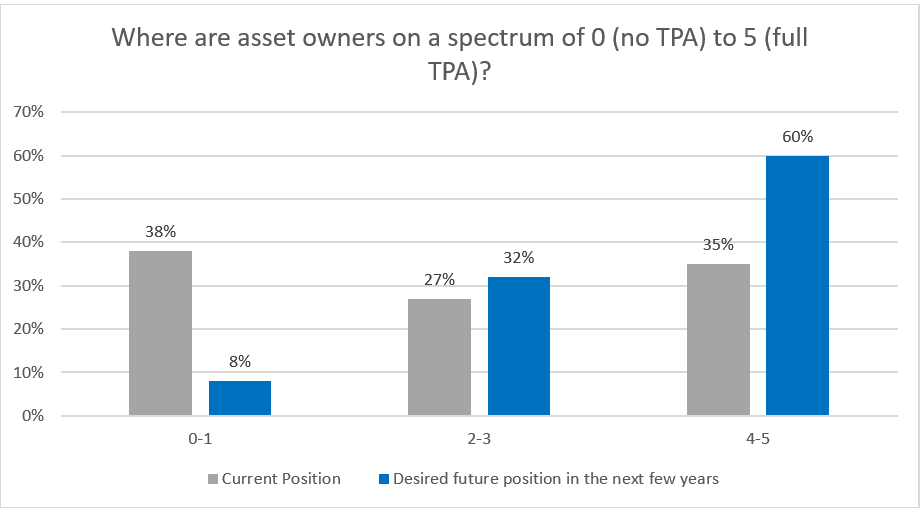
Source: Thinking Ahead Institute, WTW, Global Asset Owner Peer Case Study 20241 Assumptions, opinions, and estimates are provided for illustrative purposes only. There is no guarantee that any forecasts made will come to pass.
That shift lies at the heart of a growing TPA to investing.
From benchmark exposure to investment outcomes
At its core, TPA encourages investors to look beyond individual asset classes and instead consider how every allocation contributes to overall portfolio objectives. Rather than optimising each component in isolation, the focus shifts to how the portfolio functions as a whole.
This represents an important evolution in thinking. Historically, investors used broad bond indices as the foundation of portfolio construction. For example, the Global Aggregate represented a diversified, investable universe of investment grade-rated bonds, exposure to high-quality duration as well as exposure to key fixed income risk premia. Over time, benchmarks became an easy if imperfect proxy for investor objectives and outcomes investors wanted.
Recent market experience has shown those outcomes cannot always be assumed. The simultaneous sell-off in equities and bonds during 2022 demonstrated that benchmark exposure alone does not always provide the diversification or cushioning effect investors have historically expected.
Consequently, the relevant question is no longer, "Does my portfolio beat the benchmark?" but, "Is my portfolio delivering the outcomes I need?"
That distinction fundamentally changes the conversation.
Few institutional investors would define their objective as simply owning seven years of duration. Instead, as an example, they may seek liability matching from reliable income streams, risk mitigation during equity market stress, attractive risk-adjusted returns and diversification from growth assets. Duration is just one tool used to achieve those objectives.
TPA therefore starts with the desired outcome before determining the most appropriate investment approach, rather than assuming benchmark exposure alone will deliver the required outcomes.
Different goals for different investors
Although markets have evolved significantly, many fixed income allocators continue to seek outcomes such as:
- Reliable income
- Liability matching
- Diversification from risk assets
- Resilience during periods of market stress
- Attractive risk-adjusted returns
- Investors prioritise these objectives differently.
Two institutions with global bond mandates benchmarked to the same Global Aggregate market indices can have entirely different objectives. One may primarily value risk mitigation and low correlation with equities. Another may focus on generating higher income or improving resilience through changing economic cycles. Both reference the same benchmark, yet they define success differently.
Traditional benchmark-based investing often assumes those objectives are broadly identical. A TPA makes those differences explicit from the outset, creating a more meaningful dialogue between allocator and manager about the role fixed income is expected to play within the total portfolio.
Flexibility in pursuit of outcomes
Once investment outcomes are clearly defined, the next question becomes how best to achieve them.
Delivering consistent outcomes across changing market environments often requires greater flexibility than traditional benchmark-constrained mandates allow. This does not mean abandoning discipline or accountability; flexibility is used both to structurally enhance some characteristics (e.g. diversification, carry) and to give portfolio managers sufficient scope to adapt asset allocation as macroeconomic conditions and market opportunities evolve.
For example this may involve managing duration more actively as interest-rate risks change, reallocating between government bonds and credit when relative value shifts or accepting higher tracking error where doing so improves the likelihood of achieving long-term investment objectives.
Flexibility is not an objective in itself. It is ultimately a tool for increasing the probability of delivering the characteristics investors value most, including capital preservation, lower drawdowns and diversification from risk assets.
Viewed through this lens, the conversation begins with four questions:
- What role should fixed income play within the overall portfolio?
- Why is the current benchmark expected to deliver those outcomes?
- How can we structurally enhance the benchmark to help deliver those outcomes?
- How can we add additional flexibility to both generate alpha and aim to meet the clients’ desired outcomes?
These questions make explicit what has often remained implicit in traditional benchmark-based investing.
Global Aggregate as a practical example
We believe Global Aggregate strategies provide a useful illustration of how this philosophy can be applied.
The benchmark remains an appropriate starting point because it captures many of the characteristics investors typically seek from core fixed income, including high-quality duration exposure, broad diversification and investment grade (IG) credit. Plus, the benchmark provides transparency, accountability and an objective framework for measuring manager skill.
Under a TPA, however, the benchmark serves as a guide rather than a constraint. As market opportunities change, this may justify greater flexibility in duration, sector allocation and risk positioning where it improves the probability of meeting long-term objectives.
In the service of maintaining defensive characteristics, managers may significantly extend duration when recession risks increase. Or they could shorten interest-rate exposures to near zero as inflation pressures re-emerge. Or they might allocate more selectively across government bonds and credit markets as relative value opportunities evolve.
Similarly, allowing broader tracking-error budgets or fewer constraints on credit allocation may expand the opportunity set without changing the portfolio's long-term purpose.
This is particularly relevant during constrained market environments. When IG-credit spreads remain exceptionally tight or interest-rate volatility is unusually subdued, traditional benchmark-constrained portfolios may be forced to sacrifice defensive characteristics for modest long-term reward. A broader investment toolkit and a more holistic view of risk can provide managers with flexibility to pursue asset allocations that are more aligned with client objectives.
Greater flexibility does not imply greater risk for its own sake, but rather it provides the ability to respond when opportunities arise or when benchmark characteristics no longer fully align with investors' objectives.
Illustratively, a Global Aggregate strategy operating within a TPA framework might retain the benchmark as its reference point while allowing materially broader flexibility around duration, credit allocation and tracking error. The below table illustrates one example:
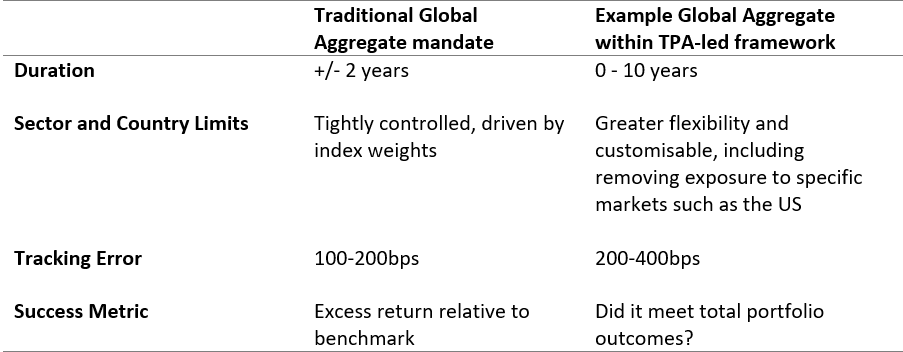
Such flexibility is not intended to maximise portfolio activity; it increases the range of tools available to preserve downside risk, enhance diversification and improve long-term risk-adjusted returns.
Ultimately, the benchmark remains the starting point – but not the destination.
From measurement to outcomes
The growing adoption of TPA reflects a broader evolution across institutional investing.
Asset owners remain committed to disciplined investment processes and rigorous accountability. If anything, the emphasis on manager skill has increased.
However, success is increasingly judged by more than benchmark outperformance. Investors want confidence that their portfolios continue to deliver the role fixed income seeks to play within the total portfolio, even as market regimes evolve.
Benchmarks remain essential to measuring progress. The differentiator, however, will increasingly be how effectively managers use benchmarks as a foundation rather than a constraint – combining accountability with the flexibility needed to deliver resilient outcomes across changing market environments.
1 “From Vision to Execution: How Investors are Operationalizing the Total Portfolio Approach” by CAIA in Collaboration with Thinking Ahead Institute (WTW). 2025-TPA-Report-from-Vision-to-Execution.pdf
Key risks
It should be noted that diversification is no guarantee against a loss in a declining market. Asset allocation is subject to change.
The value of an investment and any income taken from it is not guaranteed and can go down as well as up, and the investor may get back less than the original amount invested.
Whilst L&G has integrated Environmental, Social, and Governance (ESG) considerations into its investment decision-making and stewardship practices, this does not guarantee the achievement of responsible investing goals within funds that do not include specific ESG goals within their objectives.
The risks associated with each fund or investment strategy should be read and understood before making any investment decisions. Further information on the risks of investing in this fund is available in the prospectus here: