AI hype and hesitation: the case for an active approach to fixed income
Navigating narratives and uncertainties in AI-related bond issuance through active fixed income investing

This is the first article in a three-part series that discusses how recent advances in AI make the case for taking an active, global, and unconstrained approach to fixed income investing. Here we explore why we believe being active can help investors navigate the fast-evolving AI story.
Artificial intelligence (AI) is transforming industries around the world. While the long‑term potential of AI is undeniable, the path forward is deeply uncertain. As such, investors are laser focused on strong market narratives that quickly gain momentum and then fade on as little as news on hyperscalers’ future capex plans and model improvements. We believe it is precisely this combination of powerful storytelling, limited evidence and high uncertainty that creates potential opportunities for active investors.
Over short time horizons, financial markets are characterised by herd-like behaviour, sustained by prevailing stories and investor sentiment. This manifests in short-term price momentum, punctuated by abrupt reversals. The recent Oracle* episode illustrates this clearly.
If only we had an Oracle
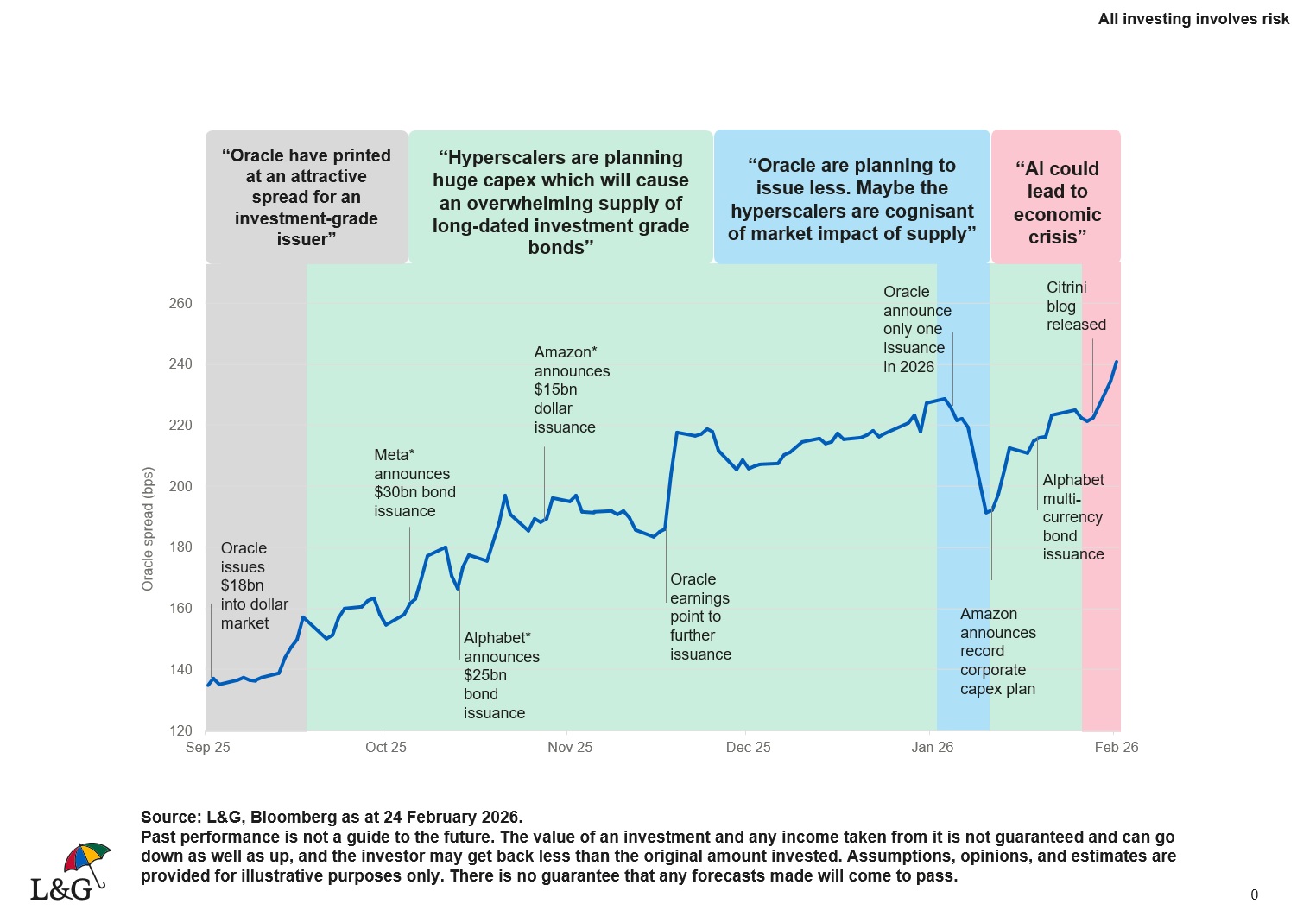
In September 2025, Oracle came to the bond market with an issuance of $18 billion which was initially met with strong demand and priced at around 130 basis points (bps) spread. Since then, the bonds have experienced several periods of volatility on news from both the company itself and the other hyperscalers. As of end 2025, the bonds were trading at over 200bps on growing fears of an overwhelming wave of capex and subsequent funding needs in 2026.
It therefore came as a relief to markets when Oracle announced on 1 February 2026 that it only intends to complete a one-time issuance during the year and that this would be accompanied by significant equity financing for around half of the required funding plans.
Within the context of growing concerns around an AI bubble, Investors were quick to interpret this news as a signal for lower supply expectations across other hyperscalers. Long end spreads in hyperscaler bonds including Oracle’s tightened as consensus formed around a new ‘base case’.
However, this consensus narrative was short lived and largely reversed days later when Meta* and Alphabet* reiterated their capex plans which exceeded even the most bullish analyst expectations.
On 22 February, the market experienced a selloff in several sectors including software, IT and financial services following the publication of Citrini* Research’s blog, which outlined a scenario where AI could soon disrupt industries and jobs, with the potential to trigger an economic downturn.
The underlying uncertainty never changed – only the narrative did.
Extrapolating the narrative
Mind the gap
So why were investors so quick to take solace in Oracle’s announcement, then change course in terms of wider hyperscaler issuance forecasts?
When faced with limited data, investors naturally tend to fill the gap with available information, weaving coherent stories that feel explanatory and predictive. Those narratives can then snowball through repetition, creating a false sense of understanding and conviction that exceeds the underlying evidence.
This is known as narrative extrapolation and is reinforced by an overconfidence bias inherent in certain investors. In this case, the market narrative went from one of “a lot of capex is coming; hence supply will increase, causing spreads to widen” to “Oracle is quite sensible, perhaps hyperscaler issuance won’t be so high” and back again in a matter of days.
What could this mean for active investors?
We do not claim to have an edge in predicting the exact source, size, currency, or tenor of the next bout of hyperscaler issuance. In truth, we don’t believe anyone should.
Where we believe active management can add value is in recognising when fragile consensus narratives are forming and preparing for how we believe markets are likely to react when those views are challenged. We try to anticipate potential inflection points by focusing on the vulnerabilities in these narratives.
This is not often a straightforward task and requires both pockets of overconfidence and consensus positions which can be challenged by known event catalysts.
AI-related bond issuance creates an almost perfect storm. Overconfidence amid high uncertainty; oversimplified, powerful narratives; and a steady flow of new information (e.g., company earnings releases) create repeated opportunities to trade actively around. Where we see overconfidence and narrative extrapolation at work, we believe there is potential to profit by taking the other side.
* For illustrative purposes only. Reference to a particular security is on a historic basis and does not mean that the security is currently held or will be held within an L&G portfolio. The above information does not constitute a recommendation to buy or sell any security.
Key risks
The value of an investment and any income taken from it is not guaranteed and can go down as well as up, and the investor may get back less than the original amount invested.
Whilst L&G has integrated Environmental, Social, and Governance (ESG) considerations into its investment decision-making and stewardship practices, this does not guarantee the achievement of responsible investing goals within funds that do not include specific ESG goals within their objectives.
The risks associated with each fund or investment strategy should be read and understood before making any investment decisions. Further information on the risks of investing in this fund is available in the prospectus here: