The Default Lens – DC Close Up
Lesley-Ann Morgan
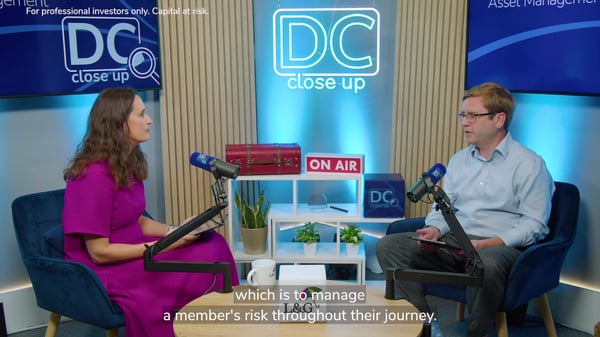
Welcome to another episode of DC Close Up. I'm Lesley-Ann Morgan, Global Head of DC in L&G's Asset Management Business. Today, we're getting closer to DC default strategies. Defaults play an important role in around 90% of UK DC pension savers being invested in their scheme's default strategy. And there are many different types, and some master trusts and independent governance committees offer more than one default. Today, I'm joined by Graham Moles, our Head of DC Strategies, to examine the different types of defaults, how they're evolving, and what happens at retirement for members both now and in the future. Welcome, Graham.
Graham Moles
Thank you, Lesley.
Lesley-Ann Morgan
Graham, let's start with one of those questions we get asked a lot about, which is target date funds versus lifestyle strategies. We moved to a target date fund a little while ago. Can you tell us more about why we selected target date funds?
Graham Moles
Yeah, it's a really important debate. Fundamentally, both a target date fund and a lifestyle is trying to achieve the same outcome, which is to manage a member's risk throughout their journey. But for us, target date funds have three key benefits over a lifestyle strategy. The first is simplicity. So, a member is in one fund for their entire journey. We believe this makes it less confusing for members and also means that there's less sort of switching between funds, which can actually add to increased costs. The second is flexibility. With that sort of structure, it's much easier for me as a fund manager to make changes to the strategy. Again, I can do that efficiently. We don't need to have confusing communication going out to members and ultimately you can save costs doing that. And the third is that it allows us to go to and through retirement. So, a lot of lifestyles will go up to the point of retirement and not beyond.
We know that many members are holding their investments for long periods of time, past retirement and saving patterns and approaches change as people age to evolve that strategy afterwards is really important.
Lesley-Ann Morgan
Now, you mentioned there about simplicity. Now, simplicity is obviously super important in DC because individuals have to take so much more responsibility than they ever did when they were in DB. Can you just give us a bit of a flavour about kind of how that simplicity comes through in defaults?
Graham Moles
Yeah, absolutely. So, DC is really complicated, but we need to make it as simple as we possibly can for members. So, one of the ways that we do that within the target date fund structure is that with that benefit I mentioned earlier of a member being a single fund, we can actually have a much more tailored asset allocation based on the age of a member, so the generation they're in. We call that generation intelligence, and what it really means is that we can invest in a different way for people who are retiring today than for people who are retiring in the future.
Lesley-Ann Morgan
And how does that kind of work in retirement? Is that where we really need to kind of understand this generational intelligence?
Graham Moles
Absolutely. People retiring today are much more likely to own their own home. They are much more likely to have a final salary pension scheme, and their DC pot is probably more modest than it would be in the future. And so actually for those members, it's really focused on protecting downside risks, because for those members, they're much more likely to cash out. If they do draw down, it'll be a relatively short period of time.
Lesley-Ann Morgan
So that's people who are kind of retiring around now?
Graham Moles
Yes, absolutely. Whereas for people that are retiring in the future, when they get to the point of retirement, it could be their only source of retirement income. And so actually the worst thing you can do is to have not enough risk. And so, what we do is try to make sure there's an appropriate level of risk for those members. And so, it's actually about thinking about the sustainability of income rather than managing that downside risk. So very different approaches for people retiring today than those retiring in the future. A target date fund structure, you can do that. In a lifestyle, it's very difficult.
Lesley-Ann Morgan
Very difficult to do that. Okay, that's good. So, if I just stick with that kind of generational idea in the member demographics, our target date funds have evolved a lot, particularly when we look at kind of 30 years before retirement, how did kind of membership data help inform you on the way in which you should design the target date fund in this particular point of the glide path?
Graham Moles
So, I think member data is really important for DC strategies at all stages. So, in the growth phase or for younger members as we describe it, we were looking at things like opt-out rates. So, our members opting out of their pension, not contributing, potentially because of a cost of living crisis or economic instability. We found that wasn't the case. So the volatility that were in markets, the cost of living issues that were going on didn't stop people contributing.
Lesley-Ann Morgan
Oh, that's good to hear.
Graham Moles
And that allowed us to take more investment risk. So, in 2025, we increased to be 100% in growth assets for younger members.
Lesley-Ann Morgan
So, I think that probably builds on a previous episode that we did on behavioural biases. Kind of how are you seeing what people are doing now? You've kind of given us the information about what you saw back then, but how is that changing now? Are you seeing anything different?
Graham Moles
So, if we move towards more the retirement stage and the innovation that we've been thinking about there, we've done a lot of times of researching our members. There are 5.8 million members that we look after and we're able to look at what they're doing at retirement versus what they say they'll do at retirement. And often those things can be quite different. So, that's one sort of aspect that we can look at. We can also look at trends and things, how things are evolving. So, for example, people with larger pots are doing things differently to people with smaller pots. And that gives us an indication of what might happen in the future when everyone's pots will be bigger. So, by taking that sort of factor on board and looking at internal and external research on retirement spending habits, how inflation links they might be, and also looking at things like the contribution of the state pension, we were able to think about how we might want to evolve our retirement asset allocation. And so, we did a big, big lot of research this year, and those changes are coming in right now. And the conclusion is that we believe we can actually improve outcomes for people close to retirement and those who will be retiring in the future. For those retiring now, we've been looking at whether we can implement our inflation protection more efficiently. A lot of spending is very inflation-linked and we believe there is a way we can do that more efficiently and that's actually allowed us to take more growth exposure, so improve expected returns without increasing risk.
Lesley-Ann Morgan
And how much different is that for someone earlier in their journey then, compared to that later part that you just talked about?
Graham Moles
So, we've been looking at how the whole environment for people retiring in the future is likely to change. And for people in the future, there will be guidance from us in terms of what level of income we think they can take, whether they're spending too quickly or too slowly, guardrails of support, et cetera. And because all that extra support is in place, we think that actually allows us to take more risk because we can help guide people to make the right decisions. So, actually the change we're making in the future is that we're expecting to take more risk at retirement for those members.
Lesley-Ann Morgan
Okay, good. Well, I think that kind of understanding of what people are actually doing and what we can do to help them take more risk while also feeling supported, I think is great.
Graham Moles
Exactly.
Lesley-Ann Morgan
Yeah. So, let's switch to revolution now then, Graham, and let's touch on value for money, one of your favourite topics, I think. So, what about this transparency about performance of the default fund? How do you think that's going to impact the way in which you're going to be managing the defaults when people are looking at them with a very fine lens?
Graham Moles
Yeah, value for money is a really, really interesting one, as you say. So it's very difficult to assess performance across different providers for a number of reasons. They might have a different member demographic to the ones that we have. Their scheme may have started at different points to ours. And so it's very difficult to sort of make that comparison, make it in a fair way. So it's a challenge to overcome and we've engaged a lot with regulators around how best to do that, fed into all the consolidation approaches, et cetera. I think when it comes to the value for money, a lot of people are talking about will there be herding? So, will everyone end up with the same asset allocation? I make no secret that we already look at peers and how they invest. I think it's a very healthy mechanism for you to be able to look at what they're doing and challenge yourself as to, are we making the right decisions? But I think we have to always remember that the member is at the heart of everything we do. So, to give you a sort of tangible example of how that emerges, a lot of our peers are invested in more, say, market cap approach within a market cap equity index there's around about 25% of the exposure of those indices are just within 10 single names.
Lesley-Ann Morgan
It's quite a lot of concentrated.
Graham Moles
Yeah, exactly. And so, we really try to think about that in a number of different ways. So, diversification, but still getting returns. So, we allocate to private markets, emerging market debts and high yield to give that diversification. But we also think very carefully about how we're implementing the equity itself. So, we think about sort of factor exposure, we think about sector, about regions, about names. So that's an example where it's a risk that we are concerned about, but we're still acting on that despite this sort of value for money framework.
Lesley-Ann Morgan
Yeah, so you've kind of got what other people are doing in the corner of your eye, but you're still thinking about the member and the portfolio yourself.
Graham Moles
That's exactly it, that's exactly it.
Lesley-Ann Morgan
Great. On this value for money point then, we've got 2 defaults, right? One's got some private assets in it and one doesn't. Do you think there'll be a split in the way in which value for money will work in the performance test for different types of defaults?
Graham Moles
Perhaps it's something that's been sort of talked about by various people in our industry so an obvious one would be that you say the private market exposure so private markets are very much long-term investments and so assessing them over a relatively short time bridge may not be that helpful so it could be that there's a split between a default that has not very many private markets and one that has a substantial amount of private markets. We do have to be really, really careful here though. So, you could quite easily get quite perverse outcomes. So, for example, ESG factors are really important the way that we invest, but it could be that those ESG factors actually provide tracking error. So, it's really important that we don't have a situation where we're encouraged to do the wrong thing. And actually, Lesley-Anne, you've just come back from Australia who I think have gone through sort of similar sort of value for money type framework. Is there anything from there that we can?
Lesley-Ann Morgan
Yeah, I think that ESG point's really well made because the Your Future, Your Super performance test, it's not quite the same as what we're going to have in the UK. It's measured against an index rather than against a peer group. But because ESG was not in the index, what happened was as soon as this performance test was brought in, everyone recognized that by having ESG in their portfolio, it created a tracking error. So either, you know, some supers basically stopped doing ESG, some basically went very light on ESG or were very conscious of the amount of tracking error that ESG was creating relative to the index. So it is something that we need to be conscious of but in a slightly different way to the Australians I think.
Graham Moles
That's really interesting. So changing track a little bit. I'm interested in your thoughts on multiple defaults. There are a number of reasons to have sort of more than one, but what are your thoughts on this?
Lesley-Ann Morgan
Well, we've got two, as I mentioned. So, we've got one that is at the lower cost end of the range, because we're in a very competitive environment in the UK. Providers are very much fighting for clients to come to their master trust. So, we've got one that's at the lower cost end, and then we've also got one that's got 15% allocation to private markets. And I think it's horses for courses. In the UK, the master trust employer is actually selecting the default on behalf of the employees.
So, the employer has to get comfortable with private assets or decide which of these two defaults they're going to go for. If you ask me whether or not you think we're going to launch another one in the near future, I don't think so. I'm not seeing a massive demand for even higher allocation to private markets than what we've got at 15%. I see some providers launching some funds that have got higher allocations, but actually they probably haven't got the money in the ground yet.
So, I would say for now, I think two probably makes sense.
Graham Moles
One area where regulation is really pushing forward our thinking is in retirement itself. With the Pension Schemes Act opening the door to default to accumulation, what do you think this means for how defaults are designed beyond accumulation?
Lesley-Ann Morgan
Yes, I think the first thing to note is that we have pension freedoms, which allows members to choose what investments they want at retirement. That is not going away. So, for those people who want to be able to choose their investments, they still can. I think the recognition from the government and the regulator is that lots of people have found that really hard. They haven't known what to invest in and they feel kind of adrift. And if they don't have an advisor or they don't want to pay for an advisor, they kind of don't know what to do. So, the idea behind having some sort of default was to particularly help those people. And at the moment, if you think about kind of what you've just been talking about, we have a to and through glide path. So, we do have something that caters for people in retirement. But I think what the Pensions Act is really asking us to do is to be much more deliberate about the way in which we think about providing a default in retirement. You know, think about the income. How are we actually going to provide that to someone? So, I think there's three points that I'd really, really focus in on when I'm thinking about designing these default accumulations, when you and I are having these conversations about how will we actually design this.
I think the first thing is most people are different. Everyone is different, right, in their retirement. Some people retire on one day and they're completely done and they go straight into retirement. Some people partially retire where they are retired, but they also are working. And there are some people who retire and then go back to work later. So everybody is different in retirement. So I think it's quite difficult to find only one solution that will fit all. So I think that's the first thing I would note. The second is about continuity. It doesn't make any sense to me that you would have an investment strategy that looks one way the day before you retire and then looks completely different the day after you retire. I think we really need to think about that accumulation and de-accumulation together when we're working our way through how people are going to get from pre-retirement into post-retirement. And then the third one, I think, is really around this area about support. People are crying out for help, as I said. Targeted support really helps people get their way through this. So, you know, there may be multiple different options for them. Each one is different.
So, it's finding the right thing for the right individual.
Graham Moles
Yeah, really agree with all that. It really resonates. Clearly there's a lot of detail to sort of still work through with the regulator and the whole industry. I think it's really important to recognise that an accumulation default is very different to a decumulation default. We know that, sort of, as she said in your introduction, more than 90% of people are in a default in accumulation, whereas in decumulation, we know that actually people will engage much more frequently than they would do in accumulation, even if it's as simple as just providing bank account details. So it could well be that the accumulation default is more about people that are unable to engage. So it could be more about our vulnerable customers, or it could be more about deferred members. And so that's a very different sort of thing to be thinking about. We also have to think about context. If a member's got, let's say, a small pot, 5,000 pounds, is it really appropriate that we put them into a default that gives them an income for life?
Lesley-Ann Morgan
Yeah, that's a fair point, because they're not going to have very much income if it's an income for life.
Graham Moles
Exactly.
Lesley-Ann Morgan
So, it's certainly a very dynamic environment, Graham. And if we reflect on everything that we've discussed today and turn the lens on ourselves, what are you most proud of in terms of the defaults that you've been working on over the last few years?
Graham Moles
Yeah, it's a really good question. I think I'm most proud of the way that we've adapted and the way that we've evolved. So, member behaviour has changed, the markets have changed. And so, I'm really pleased with the way that we've innovated to allow us to be more diversified, how we found ways to sort of increase number returns without sort of being too much risk on the table. And so, I think for me that's really the thing that I'm really pleased that we've done, really proud of, and it's something we need to keep doing. The decumulation thing we've just talked about right now is a really good example of how we're going to have to keep evolving the defaults.
Lesley-Ann Morgan
And innovating…I think what's really come home to me today in this conversation with you is that the defaults are dynamic. We have to be able to think about moving them on all the time, whether it's regulation or whether it's more information that we're getting about the members, whether it's thinking about how are their pots moving forward in decumulation? So, it's always something, it must be on your mind all the time though. And then I think the other thing is this is all about people. We are designing these defaults for individuals, and we really have to think about their needs and that's a huge responsibility. As we've already mentioned, there are a lot of people involved and invested in these defaults. So just making sure that we've really done our homework and we're really on top of the situation, I think is imperative in getting these designs right for people.
Graham Moles
Absolutely, it's a massive responsibility and it's a massive privilege, but we've got to keep making sure we all ensure those members get great outcomes.
Lesley-Ann Morgan
Well, thank you very much, Graham. I've really enjoyed the discussion today. It's been fascinating. And thank you all for watching. If you'd like to explore more on DC strategy, investment thinking, and retirement outcomes, you can find other episodes available now on our DC Close Up page. Bye for now.